
FAQs
- In 2004, Council mandated 1% affordable housing at the Prince Henry Site in Little Bay.
- In 2008 Council adopted the Affordable Housing Strategy and Action Plan 2008, being one of only a few councils to have such a plan which focused on supporting low-income residents.
- In 2019, after years of sustained advocacy, Randwick Council became one of the first Greater Sydney councils included in SEPP 70 (now under SEPP Housing 2021), and introduced affordable housing contributions in Kensington and Kingsford.
- In 2020, Council's Vision 2040 planning statement reinforced commitments to housing diversity and affordability.
- a review of essential worker housing and delivery by the NSW Government:
- That the NSW Government sets a clear framework and criteria for essential worker eligibility and a clear definition of essential workers
- Capping rent for eligible essential workers at 30% of income
- Local councils to implement affordable housing strategies as Randwick and many other councils are in the process of doing
- A state-wide affordable housing register that records essential worker housing
- Greater provision of essential worker housing in major developments and on state government land
- The Kensington and Kingsford Town Centres Affordable Housing Scheme: a scheme that levies certain large scale development in the town centres at a rate in between 3-5%;
- The Housing Investigation Areas: a scheme that levies certain parts of West Randwick, Arthur Street, Magill Street and Kingsford South at a rate of 3-5%.
What is housing stress?
Housing stress is when a household is paying more than 30% of their household income on rent or mortgage repayments. This level of spending on housing makes it difficult to afford other essential costs like food, transport, healthcare and education. This can lead to financial hardship, reduced well being and limited access to opportunities in the community.
What is affordable housing?
In general, rental housing is considered affordable if it costs no more than 30% of a household’s gross income. This level is widely used in Australia and internationally as a benchmark for housing affordability. In NSW, the 30% threshold is used as a guide to determine eligibility for affordable housing programs.
Is affordable rental housing the same as social housing?
Affordable rental housing is separate to social housing.
Social housing is mainly for people on very low incomes, older people, single parents or those with complex needs like homelessness, disability or domestic violence. Social housing is usually managed on behalf of the State Government by not-for-profit organisations such as registered housing providers, and is developed with public funding.
The graphic below shows the affordable housing spectrum, where affordable housing and social housing are two distinct types of 'non-market housing'.
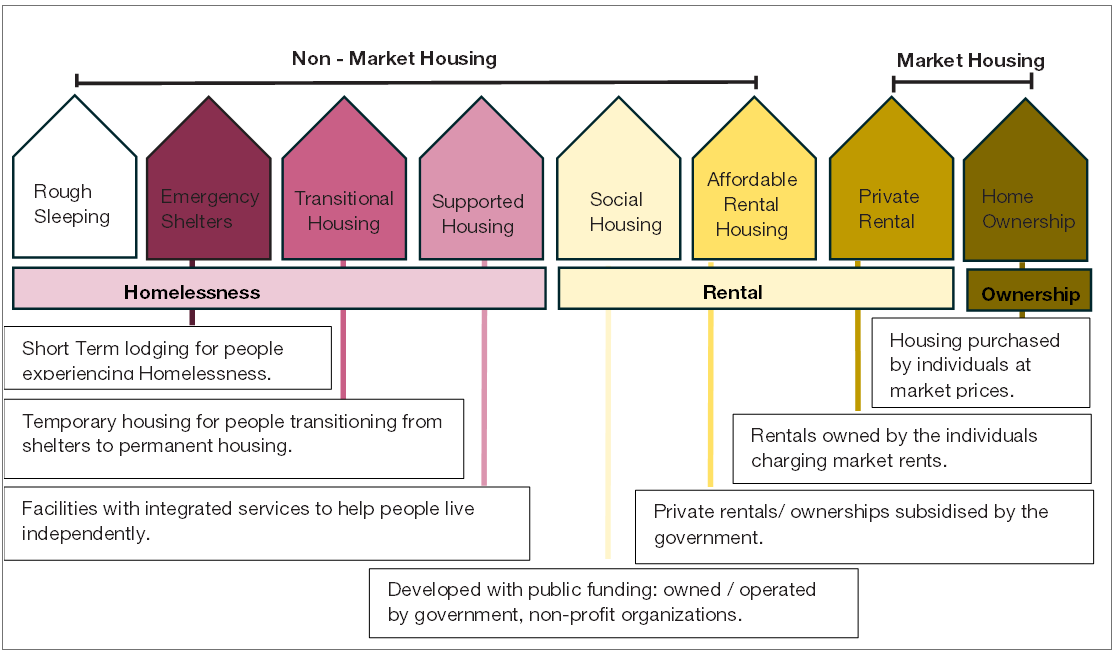
Councils can deliver, manage, and protect affordable housing, but can only advocate for increased social housing. One of our key priorities in our draft Strategy is to advocate with other government organsations to increase provision of both social and affordable housing.
Who is affordable rental housing for?
Affordable rental housing is designed to support people on very low to moderate incomes, including essential workers such as childcare staff, teachers, retail workers, aged care and health care workers. Affordable housing is managed by registered community housing providers. To be eligible, tenants usually need to meet income criteria and be engaged in employment in the local area. This helps people live closer to their workplaces and stay connected to their communities. To see income limits and eligibility, visit Appendix – Income eligibility limits affordable housing.
Affordable housing also includes ‘transitional housing’. Transitional housing provides safe and stable accommodation for individuals and families escaping domestic and family violence. This type of affordable housing is designed to support people during a period of crisis or change and typically has more flexible eligibility, especially around employment. Transitional housing offers vital pathway to recovery, helping residents rebuild their lives while accessing support services and working towards long term housing stability.
How affordable is renting in Randwick City?
As of December 2024, the average weekly rent for an entry-level unit in Randwick City was around $699, while the median rent for all units reached $800 per week. Renting a house is significantly more expensive, placing it well beyond the reach of most low-income households. This highlights the growing challenge of housing affordability in the area, especially for essential workers, young people, and families on lower incomes.
What is the income limit for affordable rental housing?
To be eligible for affordable housing, the NSW Ministerial Guidelines set a single adult income limit of $80,700 per annum (as of July 2025). Additional income allowances apply for extra family members. Eligibility limits are updated annually - see the NSW Government's webpage on eligibility limits for affordable housing for further information.
What has Randwick Council already done to address affordable housing?
Randwick City Council has been a long-standing leader in addressing affordable housing challenges, championing innovative policies and a range of initiatives for nearly 20 years.
What will Council and State Government do to ensure we provide housing for essential workers?
Council’s strategy acknowledges both the importance of essential workers, and the importance of essential worker housing to be recognised as critical infrastructure. This is particularly relevant to Randwick LGA, as it is the home to a major hospital and university.
Under the current state government framework, essential workers are not prioritised for dedicated affordable housing because the framework lacks a clear definition of “essential worker,” making it difficult to identify those most in need of support.
To address this gap, the New South Wales Parliament established the Legislative Select Committee on Essential Worker Housing. On 13 June 2025, the Committee tabled its report, which contains 20 recommendations aimed at improving housing options for essential workers focusing on:
The Government’s response to this report is due on 13 December 2025. Further information can be found on Parliament's Legislative Select Committee on Essential Worker Housing webpage.
At the Ordinary Council meeting on 17 June 2025, Council resolved that the key outcomes and actions of the Inquiry relevant to Council are incorporated into the draft Affordable Housing Strategy (post exhibition) and the next review of the Local Housing Strategy.
What is Council's role in delivering housing?
Randwick City Council plays an active role in supporting the delivery of affordable housing across the local government area. Council already levies large-scale developments in parts of the city through:
Council has endorsed a planning proposal for a similar scheme for Randwick Junction that will now proceed to 'gateway' (a determination process) by the NSW Department of Planning, Housing and Infrastructure.
The levies in all three schemes give developers the option to either include affordable housing within their projects or make a financial contribution to Council. These funds are then used by Council to deliver its own affordable housing initiatives. Through this approach, Council helps ensure that new development contributes to a more inclusive and diverse community, while also expanding the supply of affordable rental homes.
Do my rates pay for affordable housing?
No.
Most affordable housing delivered by Council is funded through its affordable housing levies (see above question for more information on these levies). Other sources include funding from the Federal Government (typically through the Housing Australia Future Fund) and from partnerships with non-for profit community housing providers. This ensures that the cost of delivering affordable housing does not fall on local ratepayers.
In addition to affordable housing schemes, Council can also use the planning system to require developers to protect existing low-cost market housing and encourage the construction of more of these homes. Council can also advocate to State and Federal Government to implement measures to reduce the cost of housing.
What is Short Term Rental Accommodation and does it have an impact on housing affordability in Randwick City?
Short Term Rental Accommodation (STRA) refers to a residential dwelling used to provide accommodation on a commercial basis for a temporary or short-term period.
The growing number of STRA dwellings available on platforms such as Airbnb and Booking.com can reduce the supply of affordable housing, and Randwick City is attractive to visiting tourists. As of April 2025, there were over 1000 STRA properties listed in Randwick City that were used for the sole purpose of STRA.
Action 1.6 of our draft Strategy states that we will investigate of the impacts of STRA across our LGA.
What are the Draft Affordable Housing Design Guidelines?
The Housing Design Guidelines are intended as a reference for developers while they are still in the early design and feasibility stages of developing affordable housing, and before they submit a development application to Council. It sets out the expectations that Council has for housing which will be dedicated to Council or intended as an 'in kind' contribution. The expectations are later formalised through conditions placed on the development consent or a Voluntary Planning Agreement.
Having the Guidelines available to developers before they submit a development application to Council reduces the chance of delays during the initial application assessment stage.